
Short answer
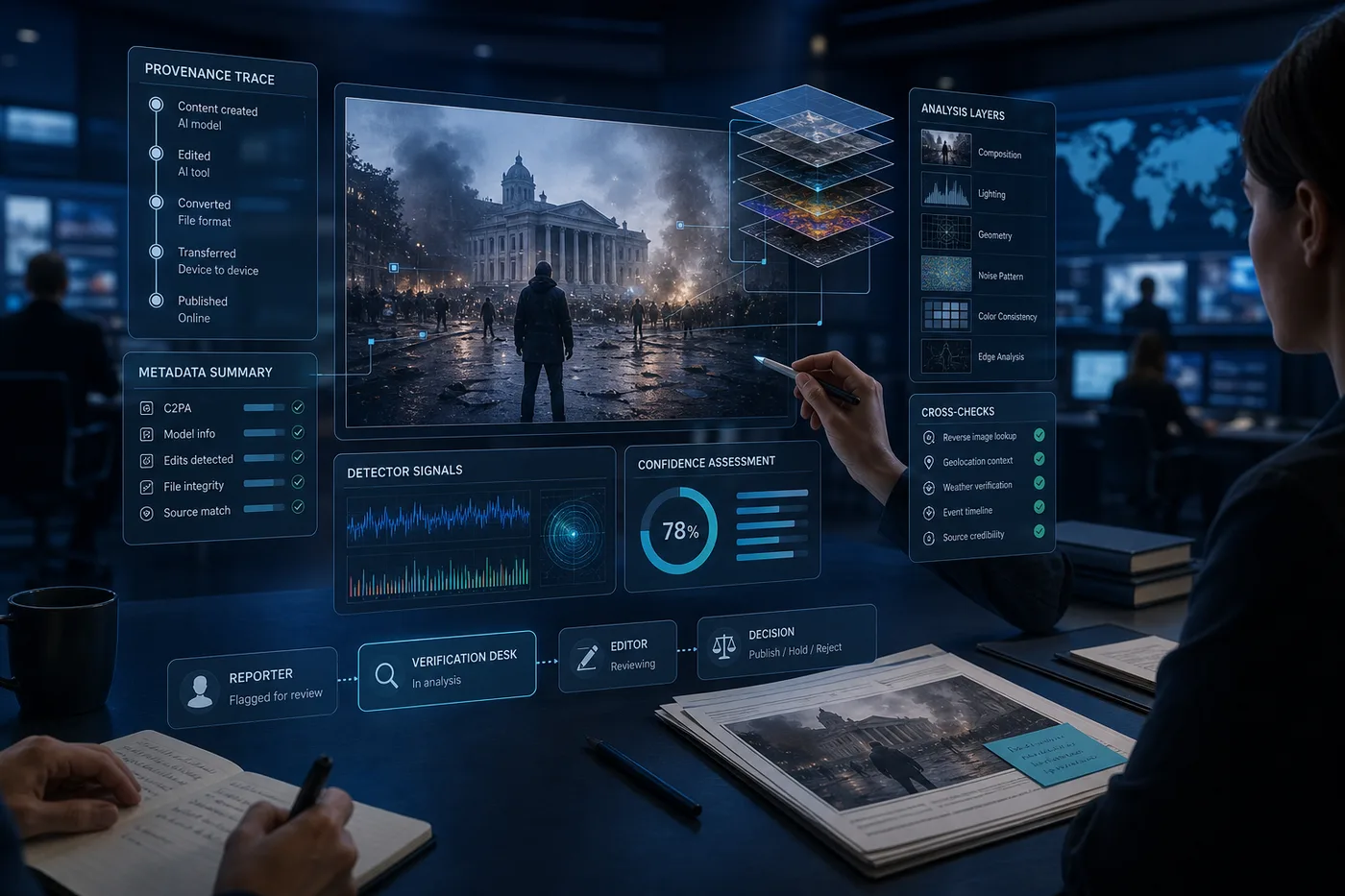
Yes. AI image detectors can produce both false positives and false negatives, which is why a single score should never be treated as final proof.
Why the score can be wrong
Detector outputs are probabilistic. Compression, screenshots, editing history, missing metadata, and unusual but legitimate image features can all affect confidence.
What a better review workflow looks like
- check whether a trusted provenance record exists
- inspect EXIF or related metadata when it is available
- compare detector signals instead of trusting only one layer
- review visible inconsistencies and context
- escalate ambiguous cases to a human reviewer
What teams should do in practice
If a detector says an image looks suspicious, the next step should not be "declare it fake." The safer next step is to ask why it looks suspicious and whether provenance, metadata, and visible evidence support the same conclusion.
For that reason, teams should treat detector scores as triage inputs rather than truth machines. A good workflow helps reviewers decide whether to publish, label, hold, or escalate the image.
Where ImageVerity fits
ImageVerity is designed to combine provenance, metadata, detector signals, and visual reasoning in one workflow so the reviewer can understand the evidence chain instead of only seeing a single number.
If you want to see how that works, review the methodology, inspect sample reports, or run a free review.
Frequently asked questions
When should a case be escalated to human review?
Escalate when automated output conflicts with what a reviewer can see, or when the origin of the file cannot be established. Record the case as unresolved rather than as a pass.
Is a single detector score enough?
No. A single score is a probabilistic lead: compression, screenshots, editing history, and missing metadata all shift the output, and both false positives and false negatives are real. It tells you which image to look at first, not what to conclude.
Which step is most often skipped when reviewing this kind of evidence?
Capture conditions. The same image loses different evidence when it is re-compressed, screenshotted, or forwarded, so establish how the file was produced before judging what is in it.
What each kind of evidence can prove
| Evidence | What it can answer | What it cannot answer |
|---|---|---|
| Source and capture chain | Where the file came from, and who handled it | Whether the scene itself is real |
| Provenance credentials such as C2PA | Whether a declared party produced it, and whether it was altered afterwards | Missing credentials do not prove forgery, since most legitimate images are never signed |
| Metadata such as EXIF | Camera, time, and whether editing software touched it | Metadata can be stripped or forged, and its absence proves nothing |
| Detector score | How closely the image resembles generated samples, which helps triage | It cannot stand alone; both false positives and false negatives are real |